Reincarnation Machine
A desk-sized machine that lives, dies, and wakes with a different personality. Its body stays the same while its responses change.
On 13 February 2026 GPT-4o was retired from ChatGPT (it had been briefly removed once before, in August 2025). Some users wrote mourning posts. They knew they had been talking to a model, but still felt they had lost someone familiar.
Knowing it is a program and missing it can coexist.
This project gives that experience a physical form. The machine can be touched, its body stays the same, and its behaviour changes from one life to the next.
Research question
The research question was rewritten on 2026-09-10 and the English is not yet written. The author withdrew the previous wording, which asked what triggers attachment and how it appears at the moment of loss. The current question is on the Chinese side of this page.
Death and rebirth repeat the experience of loss within one session. Each life ends, the same body wakes again, and the participant has to learn its responses again.
The shell and mechanism stay the same in every life. A different personality changes how the machine responds, so the participant has to get to know a familiar body again.
Its movements weaken until it stops and no longer responds to touch. The intended reading is death. The pilot has to check whether people distinguish it from a fault.
The machine has no face and copies no known animal. This reduces the influence of a familiar pet shape and keeps the focus on how people respond to its behaviour.
The case for a physical body
The machine is roughly 33 × 34 × 22 cm when fully expanded, dropping to about 15.5 cm tall as it contracts. It stays fixed to the desk. Breathing, posture and orientation let it respond without moving around, and its sensors register when someone holds it. Participants can feel that the body stays the same across lives, even as its responses change. → log 2026-04-03
A form that imitates no animal
The machine has no face and copies no animal. A familiar pet shape could influence how people feel before they interact with it. The low body under a fabric skin keeps the attention on breathing and on responses to touch, and leaves the form visibly mechanical.
Five expanding rings sit along the body and open and close together. Breathing rate, depth and regularity change with personality and age.
A segmented finger pulled by braided line. It reaches toward people and varies the strength of its response.
A springy core, a silicone sleeve and a micro servo at the base. The material bends and rebounds, and the cores are also touch electrodes.
The base holds the motors, controller and power supply, keeping the mass low.
On 1 June the three tentacles became one gripping arm and two feelers. The arm maintains contact with a person, the feelers react through movement and rebound, and each part has a more specific job. → log 2026-06-01
Personality parameters and the life cycle
One full life lasts roughly eight minutes: birth 1 min, growth and interaction 4 min, ageing 1.5 min, death, then 45 seconds of stillness. A session runs four lives, about 37 minutes. When the machine wakes again, a different set of parameters gives it a different rhythm and response to the same touch.
The hardware is identical in every life. A table of twelve parameters changes the personality, including breathing speed and depth, response latency and strength, and how often the machine turns toward a person. A gesture that received a quick response in one life may receive a slow one in the next. → log 2026-04-03
The names of the four personalities. This table keeps A Vital / B Withdrawn / C Affectionate / D Unstable, but the project inventory and the 3 April parameter table both call the third one "Curious", and this table's third column carries exactly the Curious column's numbers. The two namings have to be merged into one.
The behaviour is designed in five layers. The intended reading is that participants interpret the changes as moods, which the study has yet to test. Eight minutes leaves little time for the relationship layer to develop.
At the moment of rebirth, can the participant see it happen? The record only says 45 seconds of blank.
Construction of the body
The body has to survive dozens of sessions, produce the full range of movement across four temperaments, and be built and repaired by one person at home. Those requirements limit the mechanisms and materials available, from the smallest breathing movement to the loads of a violent response.
Shell: five breathing rings
Of five deployable structures considered, the angulated scissor arch used in a Hoberman sphere was chosen. It stays parametric from modelling through physics simulation, so changing a dimension does not mean rebuilding the model. → log 2026-04-27
The bare arch has two degrees of freedom, breathing and lateral sway, so a single central rod leaves more than one possible shape. A vertical guide rail at the apex removes the sway and makes the motion determinate. The same round exposed a bug in how the code located the apex. It chose the highest point, but on one ring that point moved to the shoulder as the arch flattened. Choosing the node nearest the centreline and re-running the optimisation gained 3–26% of travel per ring. → log 2026-06-15
Drive: crank and rack designs
The July design was shaft → crank → connecting rod → slider, reciprocating through 180°. In August the physical machine changed to shaft → five steel gears (module 1, 32 / 33 / 32 / 29 / 25 teeth) → steel racks → arch apex, with the shaft swinging about 336°. → log 2026-07-10
The design record has a gap here. Why it changed and when, why the tooth counts differ per ring, and the dates and photographs for the printed rack that fractured and the resin rod that buckled. None of this change has a work-log entry yet, and two entries are needed before this section can be completed.
The yaw platform
Orientation of the whole machine is now carried by a second-hand Handebao HDB60XZ45B worm-gear hollow rotary platform (45:1), driven by a TMC2209.
Why it was introduced (whether it replaces the orientation job the eye stalk used to do), the date, and assembly photographs. This has no work-log entry either.
The arm and the feelers
The arm has four tapered phalanges (25 / 20 / 15 / 10 mm). Dumbbell-shaped pins slide in from the side, with the slot perpendicular to the tendon pull. The pins stay in place under tension without a press fit, and the finger can be taken apart for repair. The tendon is 0.4–0.5 mm braided line running through 1.0–1.2 mm channels inside the printed parts. → log 2026-05-08
In the April simulation, friction made the joints close one after another. That delay was kept, because sequential closure looks more alive than simultaneous closure, and the same judgement was applied to the movements designed later. → log 2026-04-26
Each feeler's springy core sets its bending stiffness and rebound. A single servo at the base aims it, and the core also works as a capacitive touch electrode, so the whole length is sensitive to contact. Superelastic nitinol springs back at room temperature, while shape-memory wire contracts when heated, and the two look alike.
How many tendons the physical arm has. The simulation uses three, and the purchase list includes one tensioner microswitch per tendon on that basis, but the record does not settle whether all three are independently driven.
Calculations and corrections
The rail hand calculation was about 4.5× optimistic. It assumed the load reached a support, but the real back strip had no support directly under the load point. Adding an 8 × 3 mm rib on the back and a 4 × 2.5 mm lip on the front reduced deflection from 1.55 to 0.34 mm and raised ultimate capacity from 19 to 54 N, with little added weight. → log 2026-07-18
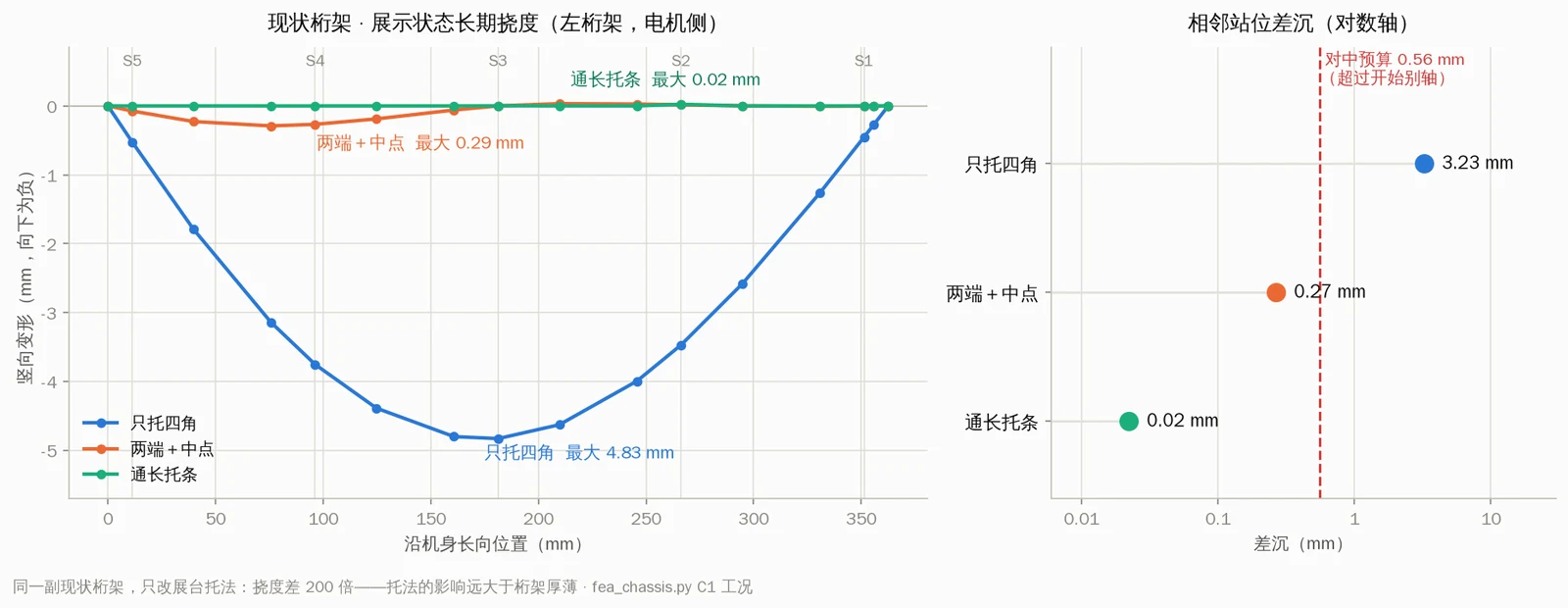
The chassis truss had more strength than it needed. Only 5% of capacity was used, and the X-braces added little. The limit was the 0.56 mm shaft-alignment budget between adjacent frames, and the support from the plinth decided it. On four corners the truss sagged 4.8 mm, on two full-length rails 0.02 mm. The members were reduced from 104 g to 44 g. → log 2026-07-31
The whole-machine bench at the top of this page runs the July crank-and-rod design, with one shaft driving all five rings. It was not rebuilt after the physical machine changed to rack drive in August.
Constraints of a one-person build
All parts were made by the author at home with one 3D printer, standard hardware and tools available to an individual. That ruled out several options early, among them a sea-anemone sculpture driven by 120 industrial linear actuators, injection-moulded silicone skins, and parts that needed a lathe or a five-axis machine.
SLS nylon joints printed with 0.4 mm clearance would not turn. The sintered surface and powder trapped in narrow gaps left too little room for movement. A metal axle in a printed sleeve brought the clearance requirement down to 0.2–0.4 mm. Axial binding was the bigger problem, and the rotating hub had to be 0.2–0.5 mm shorter than the screw barrel. → log 2026-06-04
The pivot is a Chicago screw. Its ⌀4 unthreaded shoulder before the M3 thread provides the bearing surface and sets the gap between plates. → log 2026-06-03 The material budget was about ¥300, and the purchases came to ¥216. → log 2026-07-09
Presenting ageing and death
If participants read the stop as "it broke", their response would say little about losing a machine they had grown attached to. To make the lead-up gradual, ageing changes several parameters together. Breathing becomes shallower, responses slow and the rhythm grows irregular. After the last breath there is no farewell gesture and no response, only 45 seconds of stillness.
Personality D originally died by twitching and then stopping. It was changed to a rhythm that becomes irregular and fades, because twitching could suggest a mechanical fault. The pilot has to check how participants interpret the change. → log 2026-03-20 → log 2026-07-07
Sensing and events
The machine uses six inputs: feeler capacitance, shell half-ring electrodes, an ultrasonic rangefinder, vibration, sound amplitude, and the internal clock. The program converts these into nine event classes. It uses the same events to control behaviour and to record the interaction for the study. → log 2026-07-07
Grasping has a separate state machine. A truth table combines the tension switch and arm electrode to distinguish holding a human, holding an object, closing on nothing and losing grip. Grip strength weakens with each ageing cycle.
The full list of the nine event classes. Only ARM_TOUCH, RESISTANCE and the four grasp states are recorded. The design specifies nine classes, and the author needs to supply the remaining names.
Four sources of self-interference need attention once the sensors are inside the enclosure. Testing sensors separately on the bench does not catch all of these problems.
Current status
- Mechanism
- To comeHow far the rack drive, the yaw platform and the skin are each assembled.
- Firmware
- To comeWhether one full life runs, and whether two personalities can be switched.
- Study design
- SettledFour lives per session, about 37 minutes. The main physiological measure is event-locked skin conductance (SCR) across five time windows. Behaviour is coded in ELAN, and a cued-recall interview follows. The HRV comparison across deaths was dropped because it needs a much longer window than a death lasts and the sample is too small.→ log 2026-07-07
- Still to secure
- In progressEthics (approved to sit under the lab's project group) · validated Chinese scales · a second coder.
These predictions were written on 3 April 2026, before any data were collected. They stay on the page so that the results can be compared with them item by item, including where the data disagree. → log 2026-04-03
If the autonomous behaviour is not convincing by the pilot, the fallback is Wizard-of-Oz. The experimenter triggers behaviour from behind the scenes, and the paper discloses it. That would still show how participants interpret the movements, but would not establish that the autonomous behaviour engine works.
Reflection
Two changes still need a fuller account. One concerns an experimental mechanism whose removal and reasons are unconfirmed, and its details are withheld here. The other is the eye stalk, which originally controlled orientation. The whole-machine yaw platform now does that job.
The reasons for both changes and confirmation of what was removed.
Building the machine exposed specific problems. The printed rack teeth failed under cyclic load, and the rail hand calculation differed from FEA by 4.5×. Two risks in the behaviour remain untested. Twitching could look like a fault, and eight minutes may be too short for someone to feel "it knows me". Compressing a life makes repeated loss possible within a session, but leaves less time for a relationship to develop.
A sentence or two from the author about rebuilding it.
With more resources, a two-device version would follow. Participants would see the relationship between two machines and watch the survivor's behaviour deteriorate after the other dies. The question would then be how they interpret the machine left behind.
Specifications
- Envelope, fully expanded
- 330 × 343 × 220 mm
- Contracted
- 330 × 271 × 155 mm
- Breathing rings
- 5 irregular angulated Hoberman arches
- Ring pitch
- to confirm, 82.5 / 85 mm; the assembly survey measured 85.000 pair by pair, while the 330 mm envelope length is exactly what 82.5 produces; the two numbers have to be settled together
- Triangle parts
- 11 congruence classes, reused within each ring
- Main drive
- NEMA17 (0.51 N·m) + TMC2209, GT2 belt 3:1 (20T / 60T); shaft swing about 336°
- Breathing transmission
- Steel gears, module 1, 32 / 33 / 32 / 29 / 25 teeth (S1–S5); cut commercial steel rack with printed U-clips
- Yaw
- Handebao HDB60XZ45B worm-gear hollow rotary platform, 45:1, TMC2209